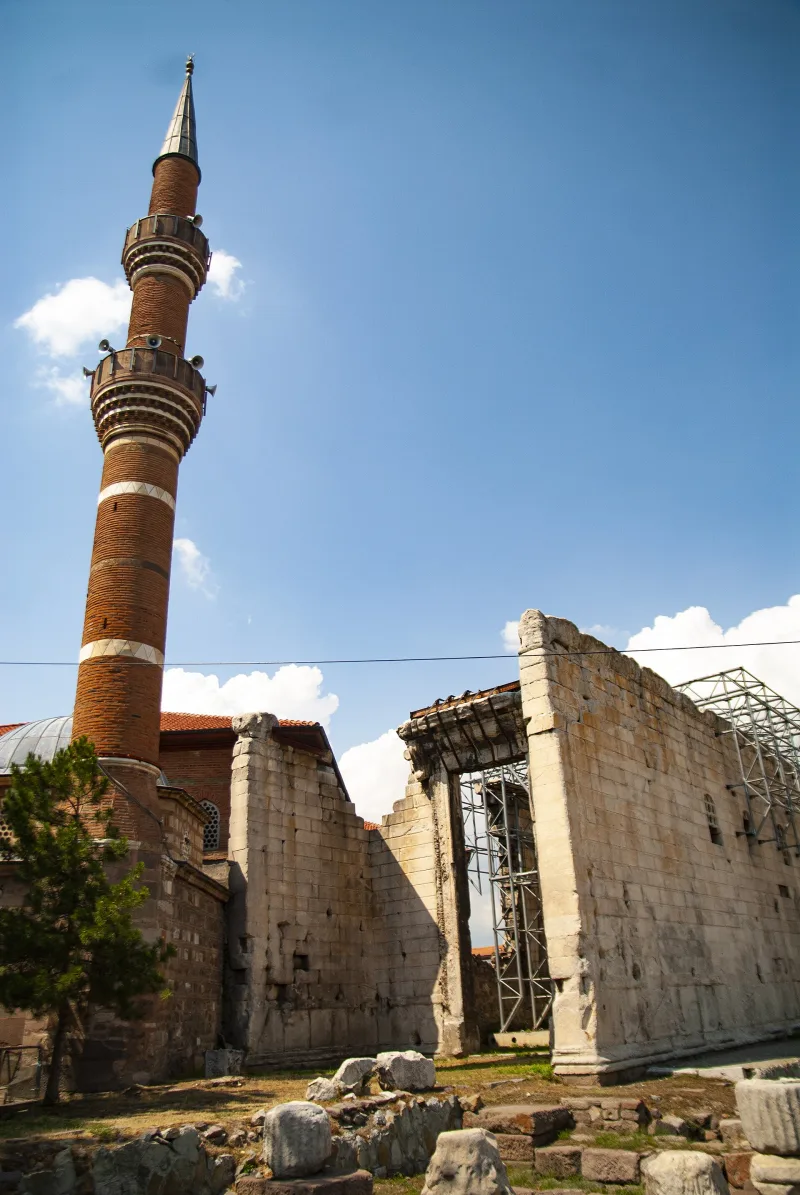
The Temple of Augustus in Ankara (Monumentum Ancyranum) — Res Gestae

Monumentum Ancyranum: Emperor Augustus’s Stone Testament

In the Altındağ district, in Ankara’s oldest neighborhood, next to the Hacı Bayram Mosque, stands an archaeological monument that draws historians from all over the world—the Augustus Tapınağı, or Temple of Augustus and Rome. Carved into its interior walls is the Monumentum Ancyranum—the most complete surviving copy of the Res Gestae Divi Augusti, the political testament of the first Roman emperor. This is the only text of such length left by the founder of the Roman Empire himself, and it has survived not in Rome, but in Ankara—thanks to a combination of circumstances and the stubbornness of stone.

History

Modern-day Ankara was known in antiquity as Ancyra and served as the center of the Roman province of Galatia, established in 25 BCE following the death of the Galatian king Amintas. As early as 25–20 BC, an augusteum—a temple dedicated to Emperor Augustus and the goddess Roma—was erected on the site of an earlier Phrygian temple (presumably dedicated to the god Mên). This was a standard design for the new cult, intended to integrate the local elite into imperial ideology.

After Augustus’s death in 14 CE, the Roman Senate decreed that his “Deeds” (Res Gestae Divi Augusti) be inscribed on bronze tablets in front of the mausoleum in Rome. The bronze originals have long been lost, but provincial copies were distributed throughout the empire. In Ancyra, the text was carved onto the stone walls of the temple itself: the Latin version inside the pronaos, the Greek translation on the outside of the cella. This is how the Monumentum Ancyranum came to be.

In the 5th–6th centuries, the temple was converted into a Byzantine church, and in the 15th century, the Hacı Bayram Mosque was built nearby, and the temple’s masonry effectively became part of its outer courtyard. The text of the “Res Gestae” was rediscovered by European scholars in the 1550s–1560s by the Croatian diplomat Antun Vrančić (Andreas Vrancsics). Since then, the Monumentum Ancyranum has been a mandatory stop for any scholarly expedition to Anatolia.

What to see

The walls of the pronaos with a Latin inscription

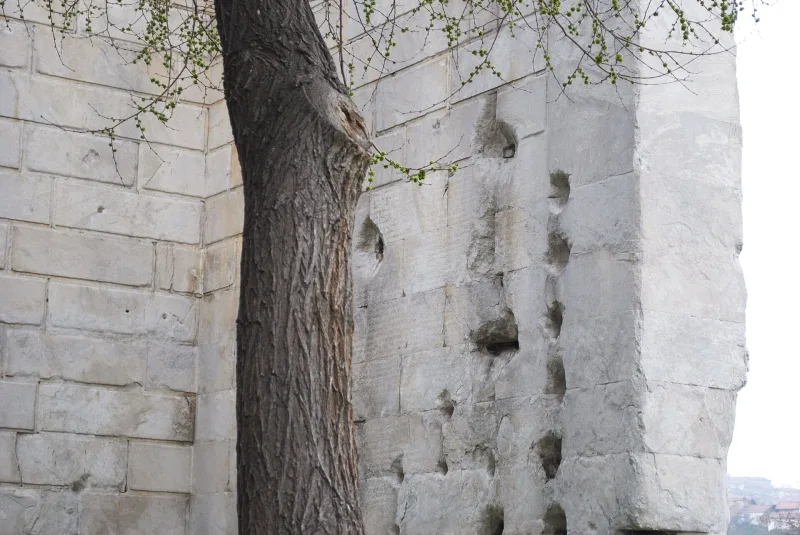
The main exhibit is the two inner walls of the pronaos (outer portico) featuring an authentic Latin inscription from the 1st century CE. The text “Res Gestae Divi Augusti” consists of 35 paragraphs in which Augustus himself lists his military campaigns, public donations, restored temples, the resettlement of veterans, and the number of gladiators in the games he organized. This is the only known document of this length written by an emperor for the general public.

Greek translation on the outer wall

A Greek translation of the same text has been preserved on the exterior of the temple’s cella—it was carved for the local population, who read Greek. This duplication of the text allows philologists to compare the versions and analyze the nuances of translating imperial propaganda into the various languages of the empire.

Doorway and side walls

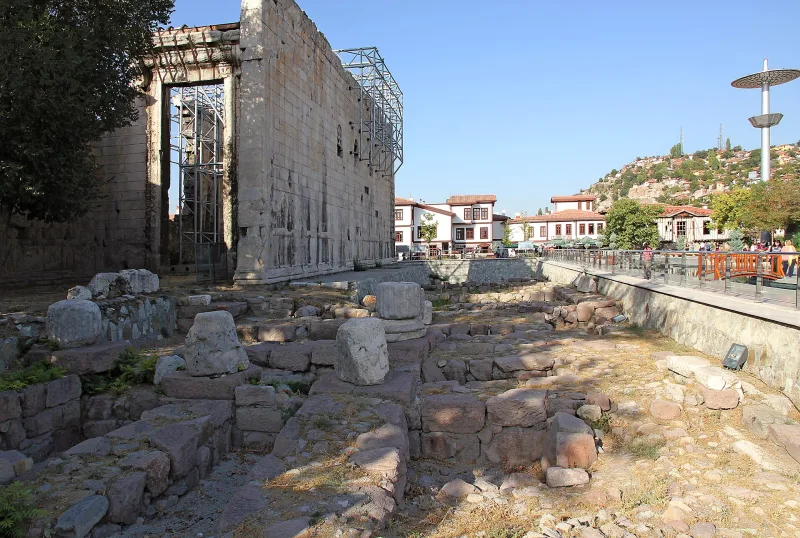
Two side walls and a richly decorated doorway with carved ornamentation have survived from the temple. Traces of the six columns of the façade are visible on the site, allowing for the reconstruction of the original plan as a prostyle with a six-column portico.

Hacı Bayram Mosque

Right next to the temple stands the 15th-century Hacı Bayram Mosque—Ankara’s second most significant shrine after the fortress. The mosque and the temple form an intriguing visual dialogue: ancient and Ottoman, pagan and Muslim, lie literally just a few meters apart. Step inside the mosque—the worshippers here are used to tourists.

Interesting Facts

  • The temple was built in 25–20 BCE on the site of an earlier Phrygian sanctuary, believed to have been dedicated to the moon god Mên or the goddess Cybele.
  • Monumentum Ancyranum is the only nearly completely preserved copy of the Res Gestae Divi Augusti, the emperor’s political testament. The bronze originals in front of Augustus’s mausoleum in Rome have been lost.
  • The Latin text is carved inside the pronaos, while the Greek translation is on the outside of the cella. This was done so that the text could be read by both the Romans and the local Greek-speaking inhabitants of the province of Galatia.
  • The text was rediscovered in the 1550s by the Croatian diplomat Antun Vrančić. A full-scale exact replica was made for the 1911 World’s Fair in Rome and is now housed in the Museo della Civiltà Romana.
  • Today, two side walls and the doorway remain of the temple; traces of the six columns of the pronaos are visible. The 15th-century Hacı Bayram Mosque stands right next to the ancient ruins.

How to get there

The temple is located in the Altındağ district, in the historic part of Ankara—Ulus—next to the Hacı Bayram Mosque. GPS coordinates: 39.9443° N, 32.8583° E. The nearest metro station is Ulus (Ankaray line); from there, it is about a 10-minute walk east through the shopping streets of the old city center.

From Kızılay (Ankara’s central square)—about a 2 km walk or one metro stop. From Esenboğa Airport—take the Havaş bus to Ulus (about 45 minutes) or a taxi. Parking in Ulus is difficult; it’s better to take the metro. The temple grounds are open-air; you can walk around both the exterior and the interior of the fenced-off area.

Tips for travelers

The best time to visit is in the morning or late afternoon: the sun coming from the side highlights the relief of the letters on the wall, making the Latin text particularly easy to read. At noon, the wall is lit head-on, and the inscriptions lose their contrast. If you’re specifically interested in epigraphy, bring binoculars or a 70–200 mm lens to examine the upper lines.

Admission to the site is usually free, and a visit takes 30–60 minutes depending on your level of interest. Before visiting the Hacı Bayram Mosque, women will need a headscarf, and everyone must remove their shoes. Please respect prayer times: tourists are not allowed to enter the mosque approximately 15 minutes before and during namaz.

Combine your visit with a tour of Ankara’s old town: from here, it’s an easy walk to Ankara Kalesi and the Anatolian Civilizations Museum (just 1.5 km on foot). This will give you a complete overview of the city’s history, from the Hittites through Rome to the Ottomans. Monumentum Ancyranum is one of those rare places where you can touch a text that Augustus himself dictated two thousand years ago. Don’t miss out on this experience.
Your comfort is important to us, click on the desired marker to create a route.
Meeting for minutes before
Yesterday. 17:48
Frequently asked questions — The Temple of Augustus in Ankara (Monumentum Ancyranum) — Res Gestae Answers to frequently asked questions about The Temple of Augustus in Ankara (Monumentum Ancyranum) — Res Gestae. Information about the service's operation, capabilities, and use.
The Monumentum Ancyranum is the most complete surviving copy of the Res Gestae Divi Augusti—the political testament of the first Roman emperor, Augustus—carved into the walls of the Temple of Augustus in Ankara. The original bronze copies that once stood near Augustus’s mausoleum in Rome have long been lost, so this 1st-century CE stone copy is the primary source of the text for historians around the world.
These are 35 paragraphs dictated by Augustus himself shortly before his death. In them, he recounts in the first person his military victories, public donations, restored temples, the resettlement of veterans, and the number of gladiators in the games he organized. In terms of genre, it is at once a political report, propaganda, and a personal chronicle of the era.
After Augustus’s death in 14 CE, the provinces of the Roman Empire received copies of his *Acta* to promote the cult of the emperor. In Ancyra (modern-day Ankara), the text was carved directly onto the temple walls—the Latin version inside the pronaos, the Greek translation on the outside. Stone proved more durable than bronze: the Roman originals in front of the mausoleum have been lost, while the walls in Ankara have endured.
The province of Galatia was bilingual: Roman officials and the army read Latin, while the local population read Greek. This dual version ensured maximum reach for imperial propaganda: the Latin text was placed inside the pronaos for the official audience, while the Greek translation was placed outside the cella so that any passerby could read it.
The text was rediscovered in the 1550s–1560s by the Croatian diplomat Antun Vrančić (Latinized name: Andreas Vrancsics), who was traveling through Anatolia. Since then, the Monumentum Ancyranum has become a must-see destination for all scholarly expeditions to the region. A full-scale exact replica of the inscription was created for the 1911 World’s Fair in Rome and is now housed in the Museo della Civiltà Romana.
Before the construction of the Augusteum in 25–20 BCE, this site is believed to have been the location of an earlier Phrygian sanctuary dedicated to the moon god Mên or the goddess Cybele. The Romans incorporated the old sacred site into the new religious complex—a standard practice for integrating local religious traditions into imperial ideology.
Two side walls of the temple, a doorway richly decorated with carved ornamentation, and the remains of six columns from the façade have survived to this day. Based on these remains, scholars have reconstructed the building’s original layout as a prostyle with a six-column portico. Enough of the inscriptions on the walls have survived to reconstruct the full text of the Res Gestae.
The site has a rich and complex history: in the 5th–6th centuries, the temple was converted into a Byzantine church, and in the 15th century, the Hacı Bayram Mosque—Ankara’s second most significant religious site—was built right next to it. The temple’s masonry effectively became part of the mosque’s outer courtyard. Today, the ancient ruins and the Ottoman mosque stand just a few meters apart, creating a rare architectural dialogue between different civilizations.
Admission to the open-air section of the Temple of Augustus is usually free. A tour takes between 30 and 60 minutes, or up to 90 minutes if you have a keen interest in epigraphy. Visiting the nearby Hacı Bayram Mosque is also free, but certain rules must be observed: remove your shoes, women must cover their heads, and avoid entering during prayer times.
Yes, the site is of interest to a wide audience. Even without knowledge of Latin or Ancient Greek, the walls bearing inscriptions dating back two thousand years make a strong impression. The context is easy to grasp thanks to the explanatory signs on site. Nevertheless, history and epigraphy enthusiasts will gain much more from the experience: it’s worth reading at least a summary of the *Res Gestae* beforehand.
The temple fits perfectly into a walking tour of Ankara’s historic center. From here, it’s about 1.5 km to Ankara Kalesi Fortress, which offers panoramic views of the city, and to the Anatolian Civilizations Museum—one of Turkey’s finest archaeological museums. Together, these three sites offer a comprehensive overview of history, spanning from the Hittite era through ancient Rome to the Ottoman period.
User manual — The Temple of Augustus in Ankara (Monumentum Ancyranum) — Res Gestae The Temple of Augustus in Ankara (Monumentum Ancyranum) — Res Gestae User Guide with a description of the main functions, features, and principles of use.
Plan your visit for the morning or late afternoon: the side lighting highlights the relief of the letters on the stone, making the Latin inscription most clearly legible. At midday, the wall is lit head-on, causing the inscriptions to lose contrast and appear indistinct in photographs. Spring and fall are the best seasons: comfortable temperatures and soft light.
The most convenient route is to take the Ankaray metro to Ulus Station, then walk east for about 10 minutes through the shopping streets of the old city center. From Kızılay, it’s one stop or a 2-kilometer walk. From Esenboğa Airport, take the Havaş bus to Ulus (about 45 minutes) or a taxi. Parking in the area is difficult, so the metro is preferable.
If you’re interested in epigraphy, bring binoculars or a camera with a 70–200 mm lens: the upper lines of the inscription are high up and difficult to make out without optical aids. Women should bring a headscarf to visit the Hacı Bayram Mosque. Comfortable shoes are a must—the ground is rocky, and the rest of the walking route through Ulus will take several hours.
Enter the fenced-off area of the temple and, first of all, examine the interior walls of the pronaos—the Latin version of the *Res Gestae Divi Augusti* is carved there. Read from top to bottom as you move along the wall: the text is organized into paragraphs. Note the condition of individual fragments and the places where the stone is damaged.
Walk around the temple and locate the outer wall of the cella, where you’ll find a Greek translation of the same text. Compare the length and condition of the two versions. If you know Greek or Latin, this is a rare opportunity to read an authentic 1st-century CE imperial text directly on the original stone. Also take a look at the doorway with its carved ornamentation.
The 15th-century mosque stands right next to the church. Please remove your shoes at the entrance; women should cover their heads. Be mindful of prayer times: tourists are not allowed to enter approximately 15 minutes before and during prayer. Worshipers are accustomed to tourists, but please behave quietly and respectfully. The mosque’s interior reflects the centuries-old coexistence of different cultures in one place.
After exploring the church and mosque, head to Ankara Kalesi (about a 1.5-kilometer walk)—from there, you’ll enjoy a panoramic view of the entire city. Then visit the Anatolian Civilizations Museum, located right next to the fortress: the exhibition covers the period from the Paleolithic era to the Ottoman era and provides a complete historical context for everything you’ve seen that day.